The history of editing
Editing was originally created to settle a bet between two men who wear arguing over weather or not a horses legs leave the ground as it runs. in order to settle the argument the man who thought of a way to settle the argument by setting up a large line on still image camera's then using a flip-book, his name was Eadweard Muybridge \/ THIS GUY RIGHT HERE \/

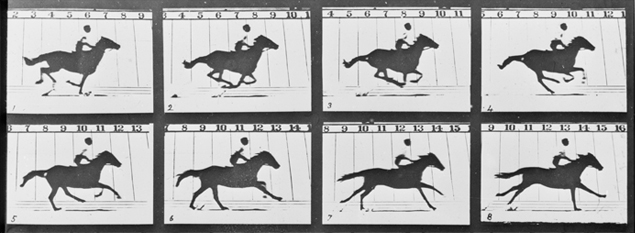
https://www.youtube.com/watch?v=YeRbwhfaHfQ
The first film cameras where single shot shorts shot from a single point of view and mostly focused on using in camera editing. this process is comprised of the usage of the cameras in built footage storage and filming the film in a linear format that can be instantly made into films. Such footage had little to no editing in the post-production stage.
Even in modern times this editing technic is still used an example of this can be found at the Straight 8 film festival

An older example of in camera editing is the 1902 history of an american firefighter https://www.youtube.com/watch?v=jXL_djAd3MA While in camera editing doesn't allow the user to move footage around as you could with film or digital edits. It greatly affects the way scenes are constructed as the director will know that they only get one shot to create the scene they want and that there can be on re-shoots. and before I move to more recent ( Slightly) forms of editing, here a more modern example of in camera edits https://www.youtube.com/watch?v=WwKJeqGeMPw
As I was saying before while editing in camera make have served as a good start off point and forced directors to consider the shots before moving on not forgetting the amount of footage that could be captured. Early forms of out of camera edits where done by the film team cutting sections of the film with scissors and then tapping it back together


 With the addtion of audio to video tape cutting the edits required greater care.


For a long time this was a labouring process done by hand that require the ut-most attention from those cutting and the help from a magnifying glass in order to gain extra focus on the film. Lucky in 1924 a man called Iwan Serrurier created the very first mechanical editing system to cut and edit films and founded a company around it called Moviola. Below is one of his devices

This machine lead to Linear Editing a process of bring clips together in a format that would allow you to play them one after the other from 1920 until 1945 the majority of editing was performed on Moviola Decks however in 1945 a german company released a device called the Steenbeck

This new machine took the editing industry by storm rapidly being taken up by industry as the tool to have when editing films. Even today the Company SteenBeck still creates editing tools for the media industry

https://www.youtube.com/watch?v=3UxuWpz7f48
/\ Quick clip of editing with a Steenbeck /\
In 1951 the Ampex research team(an American company based in Redwood City, California) had the idea to try and record to something other than standard film, video tape.

The first video editing devices were created in 1956 a few years later

The AMPEX VR-1000 recorded a black and white picture with a mono sound on a 2 inch
wide video tape.
(The tape ran at a familiar and economical 15-inches per second.) <¬ not sure what speed that is
The images were recorded across the tape from top to bottom using four heads on
a rotating drum (Quadruplex recording(The name "quadruplex" refers to the use of four magnetic record/reproduce heads mounted on a headwheel spinning transversely (width-wise) across the tape at a rate of 14,400 rpm for NTSC 525 lines/30fps-standard quad decks, and at 15,000 rpm for those using the PAL 625 lines/25fps video standard.). This set-up gives a
video recording speed of around 1560 inches per second.

The original video editing systems were linear in their use but instead of cutting data was copied from one tape to another using a control deck as a medium to set the in and out points within the clip.
Using these early techniques the quality was low by our standards by far, even by the standards of the time the footage was only good enough to be used by the smaller screens of TV.
The earlyiest full feature film shot onto video was Julie and julia in 1987 https://www.youtube.com/watch?v=1EjVWYG1E_c
we now move on to non linear editing. The first attempts of non linear editing took place in the 1970s but no one was able to create a function system for the wide spread market. Lucas films attempted to create one such product with their EditDroid in the 1980s, the product failed to take hold in the market.

The first commerically successful non linear editer appeared in 1989 when a company called Avid released their AVID media composer editing system (this company still creates Industry standard software to date) based on the Apples computer tech.http://www.youtube.com/watch?v=js_eS6bFwdc
As you can see in the video the Avid system used components such as Bins that we take for granted as standards in digital software today, however at the time Avid was the first to release such a program. This idea was helped with the introduction of Digital film and the Idea that Film could be produced on it, without digital we might not have access to Non-Linear Editing(or camera phones). Once the footage was made digital it became changeable in never before possible ways.
Purpose
Story telling is key in any piece of media you make, if your story fails to make sence of add up in certain ways people will start to question or doubt your film, Sometimes people question what will happen can be a good thing, however lets not go into that right now.Story telling is framed and created based on the Scenes and information fed to your audience or in Clive's terms their Point of View.
http://www.youtube.com/watch?v=qZsnaOQwOlI In some genres such as horror the audience is fed suspense and shock
A genre defines what kind of film you are watching, it's settings characters and even plot will fit within certain confines of the genre. For example it would be rare to find a romance without conflict between two star crossed lovers who for the reasons the conflict brings can not be together until they over come the conflict.
The pace and rhythm of a film can affect how an audience will feel about the setting. Long cuts for build up and short cuts for action, panic and drama. http://www.youtube.com/watch?v=WdUyHe7XTEY the longer the scene the more information is being sent to the veiwer, early within films this is essential for conveying story, however if these scenes fill too much on a film they can push viewers away due to their being little in the way of interest and character progression which is mostly found within conflicts that must be over come.
http://www.youtube.com/watch?v=s-nn5nrymlE The following clip from the League of Extraordinary gentelmen starts with the main characters in a ambush situation, as the clip goes on it explains how they escape and why, however it ends with one large question unanswered. the combination of shots is altered so as to create confusion and realisation for the viewer, in the second shot one of the gun men aims at a main protaganist and winks we then get a shot of the protagonist confused, then back to the gun man who fires at his own allies.
180 line http://www.youtube.com/watch?v=vhuxu-AkqNg
Montage usage http://www.youtube.com/watch?v=QQK5xJal68c can be used to rapidly progress the story line and or passage of time.
Montage usage http://www.youtube.com/watch?v=QQK5xJal68c can be used to rapidly progress the story line and or passage of time.
And now thats done here Howls moving castle http://www.youtube.com/watch?v=bHTrnAVPens. Personally I think it's a good example of great film poor trailer.
